Shuttleworth Race Day Air Show
2026 saw the final lap for the Shuttleworth Race Day Air Show. Introduced in 2016, the event showcases Richard Ormande Shuttleworth’s passions for motorsport and aviation. The final edition saw some beautiful autumnal weather, perfect for the large gathering of historic racing cars and bikes plus a very varied, and colourful flying display. Amongst the many highlights was three-ship of potent warbirds to represent the Unlimited racers in the US and a salute to racing and test pilot, Alex Henshaw.
Paul Johnson/Flightline UK reports. All photography by the author.
‘Race Day’ has been the season closing display at Shuttleworth for 10 years. As well bringing together an incredible collection of pre-war motor-racing vehicles, it has produced some unique flying displays over those 10 years, including some spectacular recreations of the Red Bull Air Race and some one-off combinations of aircraft to mark various air racing competitions. However, it has never really proved as popular as other Shuttleworth air shows despite some excellent line-ups. Therefore, 2026 saw the final ‘Race Day’ and from 2027 the Shuttleworth Collection will end its flying season with the ‘Season Finale’ held on the last Saturday of September.
The final Race Day took a similar format to previous editions with much of the paddock area given over to the historic vehicles. An unusual addition to the paddock was a demonstration of the equine sport of ‘Tent Pegging’ where riders use lances or swords to strike small targets at speed. The sport originated from military Cavalry exercises.


The flying display brought together aircraft from both the collection and visiting operators to celebrate various forms of air racing as other small sub-themes. It opened however with the Flying Comrades of Phil Hardisty, Alex Lewton and Tom Turner flying the Yakovlev Yak-18T and a pair of Yak-52s. Well-known for their displays at Duxford, the team have spread their wings in recent seasons displaying at various other venues around the UK including the large seaside airshows at Blackpool and Clacton. They have also developed their routine, which is now a very tight and flowing sequence of formation and solo aerobatics.
Vintage gliders also featured in the display with the Slingsby Petrel and Kirby Kite both performing in separate displays. The display by the Petrel was notable on two accounts. Firstly, it was towed into the air by David Findon’s unique de Havilland DH82a Tiger Moth, the last of its type still equipped as a glider tug. The Petrel was also flown by Graham Saw who chose Race Day as his final display before retiring from airshow flying. Graham has long been involved with glider aerobatics and display flying, and he has played a major role in Shuttleworth displays for many years.


There were a couple of collection displays that deviated from the racing theme. The Blackburn B2 flew as the ‘joker’ act while the Tiger Moth and Petrel combination climbed for height. There was also a salute to Bedfordshire’s aviation heritage with the unusual pairing of Westland Lysander IIIa and Percival Provost T1. The Lysander’s Bedfordshire connections from operations mounted on the type from RAF Tempsford during the Second World War in support of the Special Operations Executive. Percival, who produced the Provost and the later Jet Provost, were headquartered at Luton Airport, just a few miles south of Old Warden.
There were also two sections of flying devoted to First World War aircraft, some of which can trace history in the world of air racing. The first section focused on Sopwith products with the Sopwith F.1 Camel, Sopwith Triplane, Sopwith Pup and P&A Woods’ Sopwith Dove all taking to the air. The second section covered a wider range of aviation companies with the Avro 504K and Bristol M.1C flying with David Bremner’s Bristol Scout reproduction. The Avro 504K does have an interesting air racing history as it represented Lancashire in the War of the Roses air race in October 1913 where it was pitched against Yorkshire’s Blackburn Type 1. The Scout also has links to civilian sports flying as initially the design was promoted for recreational flying before being developed further for military purposes.


The centrepiece to Race Day flying displays over the last 10 years has been a ‘Mock Air Race.’ These have involved all manner of types, many not connected with air racing in anyway. However, the selections have all had a disparate array of performance to highlight the handicapping system that is fundamental to a lot of air race competitions. This year saw Polikarpov Po2, Southern Marlet, Comper Swift, Avro C19 Anson and Gloster Gladiator all take part. The Po2 started the race first with the fastest aircraft, the Gloster Gladiator taking off last. The aim of the handicap is that if every aircraft is flown perfectly, all participants cross the finish line together. However, as in previous years it didn’t quite work out that way, with the Southern Marlet just pipping the Po2 to the line. This is perhaps that to keep the course in the line of sight of the crowd throughout, it is not quite a big enough circuit for aircraft performance to effect the results.
The inter-war period of air racing was well represented by Old Warden based types. Steve Jones flew his somewhat lively de Havilland DH71 Tiger Moth reproduction early in the display. One two of these aircraft were built originally to research high speed flight and as testbeds for a variety of aero-engines. They were also entered in air races, including the 1927 King’s Cup. The King’s Cup Air Race was also highlighted in a later display with the very colourful trio of Desoutter I, Miles Messenger and the gorgeous Miles Hawk Speed VI.


A regular participant in Race Day flying displays is the Aircraft Restoration Company’s Supermarine Spitfire PRXI PL983. This Spitfire was gifted to the American Air Attaché, Livingstone Satterthwaite, post war. It was while under stewardship of Satterthwaite that the Spitfire was entered into several civilian air races flown by Air Transport Auxiliary pilot Lettice Curtis. In 1948, Lettice flew the Spitfire in the Lympne International Air Races and broke the National 100km close-circuit record, recording an average speed of 313.07mph. In the month prior to Race Day, PL893 gained a new identity as an aircraft of the 14th Photographic Reconnaissance Squadron, part of the 7th Photographic Reconnaissance Group USAAF, based at Mount Farm in Oxfordshire. Specifically, the aircraft represents Spitfire PA892 ‘My Darling Dorothy.’ It was flown in great style in the October sunshine by managing director of ARCo, John Romain.


Paul Freeland’s very elegant SIAI-Marchetti SF260 represented more modern types used in air racing. Paul gave a very smooth aerobatic routine in the Italian touring and training aircraft which is the oldest production SF260 still flying.
A good portion of the flying reflected the various classes that make up the National Championship Air Race formally held in Reno, Nevade and now in Roswell, New Mexico. The Pitts Special is a popular type in the biplane class racing and Charlie Coode gave an excellent account of his Pitts S-2S Special’s punchy performance in a crisp aerobatic routine.


Andy Goodall flew North American (CCF) Harvard IV ‘Wacky Rabbit’ to represent the T-6 classes at Reno and Roswell. This Harvard is not stranger to Old Warden and is often seen at the Air Shows offering experience flights to visitors. Just in time for Race Day, it gained some additional colour on the nose with some poppy vinyls to highlight Remembrance commemorations in early November.
The highlight of the NCAR themed displays was a trio of potent warbirds representing the famous ‘Unlimited’ class. Heading up this trio was Fighter Aviation Engineering Ltd’s Hawker Fury ISS flown by Steve Jones. He was joined by the Fighter Collection’s Grumman F8F-2P Bearcat piloted by Stu Goldspink and John Dodd flying Marcin Kubrak’s North American P-51D Mustang. The trio flew a lovely, crowd-pleasing tailchase routine to start their sequence which kept the three, big fighter aircraft as close to crowd as display regulations allow. After several passes, the trio broke with each aircraft giving its own solo display allowed some of the performance of these highly potent aircraft to be shown in the intimate confines of Old Warden Aerodrome.
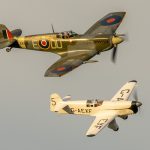
Closing the main part of the flying display was a tribute to legendary air racing and test pilot Alex Henshaw. This saw Percival Mew Gull G-AEXF make its return to public displays after a two-year refurbishment at Old Warden alongside the collection’s Supermarine Spitfire Vc. The Mew Gull now appears in the Henshaw House colours of overall white with racing green highlights. Henshaw flew G-AEXF to victory in the 1937 London-Isle of Man and 1938 King’s Cup Air Race. However, perhaps his most famous accomplishment in G-AEXF was to set the record in 1939 for flying 12,754-miles from Gravesend to Cape Town and back again in 4 days, 10 hours and 16 minutes. It was a record that stood for 70 years. During the Second World War, Henshaw joined Vickers-Armstrong as a test pilot. Initially based at Brooklands testing the Wellington, he moved to Castle Bromwich in 1940 to test Spitfires. It is estimated that Henshaw flew 10% of all Spitfires and Seafires ever built, often flying 20 a day and sometimes in poor weather. The pairing of Mew Gull and Spitfire has been done in the past, but in the golden, late autumnal sun it looked simply sublime.


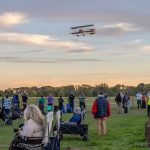
The fine weather and light winds allowed for two further aircraft to take to the air. The English Electric Wren is perhaps the most improbable flying machine in the collection and in the near still air managed a decent hop down the runway. After the Wren, there was then just enough light for the Bristol Boxkite to bring an appropriate end to the Shuttleworth Collection’s flying season set against a striking sunset cloudscape.




The final Race Day was an excellent conclusion to the Shuttleworth Collection’s summer season of airshows with glorious conditions and some standout flying. At times, it has been a challenging season for the collection with two incidents that resulted in significant damage to the Avro Triplane IV replica and the DH88 Comet, fortunately without serious injury to the respective pilots. However, those tough moments should not take away the excellence the Shuttleworth Collection achieved in 2026, particularly with the Festival of Flight and Summer Air Show which were stand-out highlights of the entire UK season. That excellence is bringing results with the Shuttleworth Collection airshow attracting new and bigger audiences – long may that continue.